
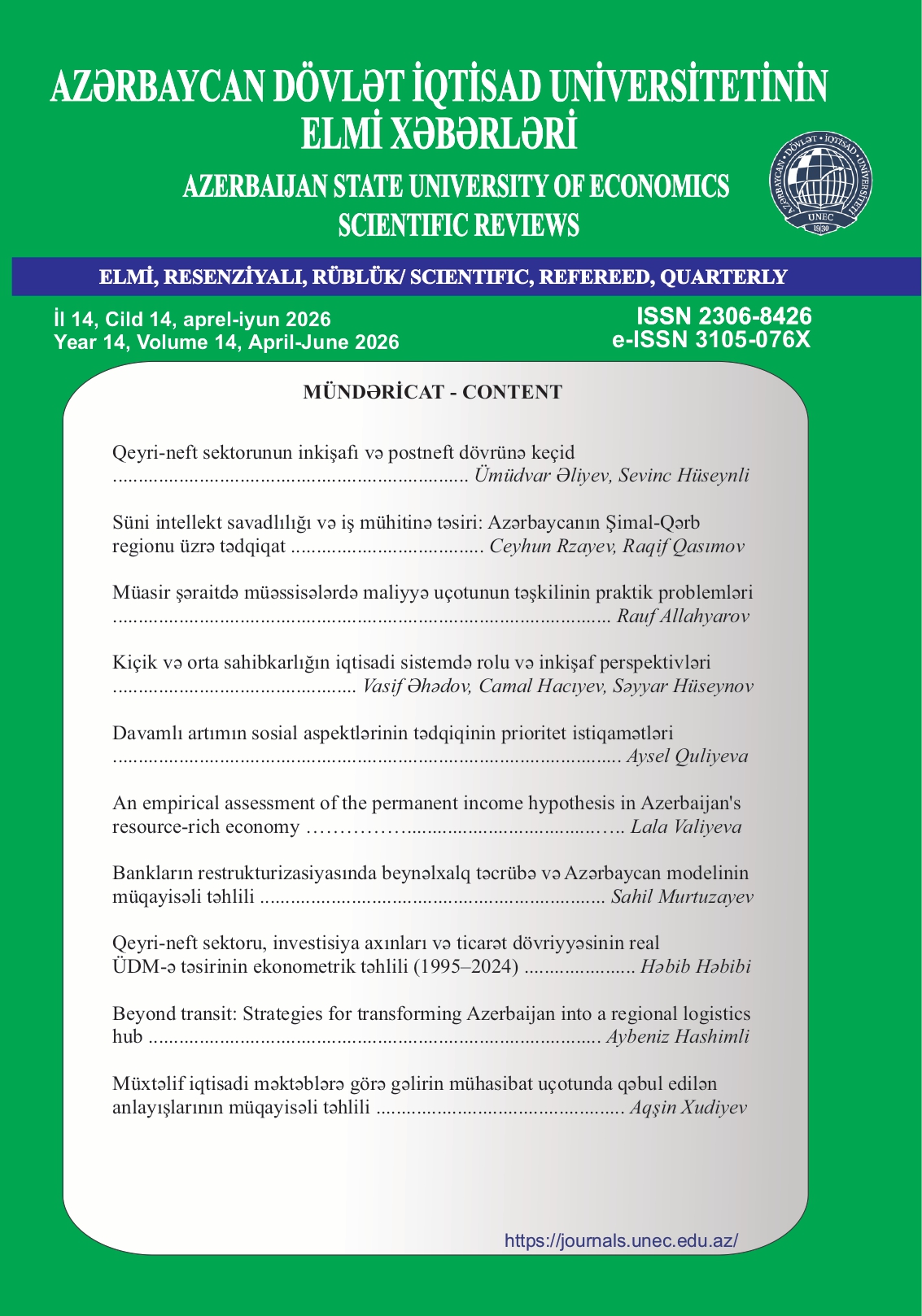
ARTIFICIAL INTELLIGENCE LITERACY AND ITS IMPACT ON THE WORK ENVIRONMENT: A STUDY OF THE NORTH-WEST REGION OF AZERBAIJAN
DOI:
https://doi.org/10.30546/UNECSR.2026.02.319Keywords:
artificial intelligence, AI literacy, work environment, productivity, digital transformation, North-West region.Abstract
This research examines the integration of Artificial Intelligence (AI) into the professional environment and employees' attitudes toward these technologies in the North-West region of Azerbaijan. The study aims to determine the level of AI tool usage, its impact on work processes, and current approaches regarding occupational security. The research was conducted in February 2026 using a mixed-methods and descriptive design. Data were collected through face-to-face surveys from 47 participants representing various economic sectors. Quantitative data were analyzed using descriptive statistics, while open-ended responses were analyzed through inductive thematic analysis. The results indicate that the majority of respondents perceive AI as a tool that increases operational efficiency and work quality. However, there are certain concerns regarding job loss and long-term skill degradation. The study reveals that AI usage in the region develops primarily through individual initiative, and the level of institutional support varies across sectors. The findings emphasize the importance of organizational strategies and structural support for a more systematic and sustainable integration of AI.
Downloads
Published
Issue
Section
License
Copyright (c) 2026 Jeyhun Rzayev, Ragif Gasimov (Author)

This work is licensed under a Creative Commons Attribution 4.0 International License.