
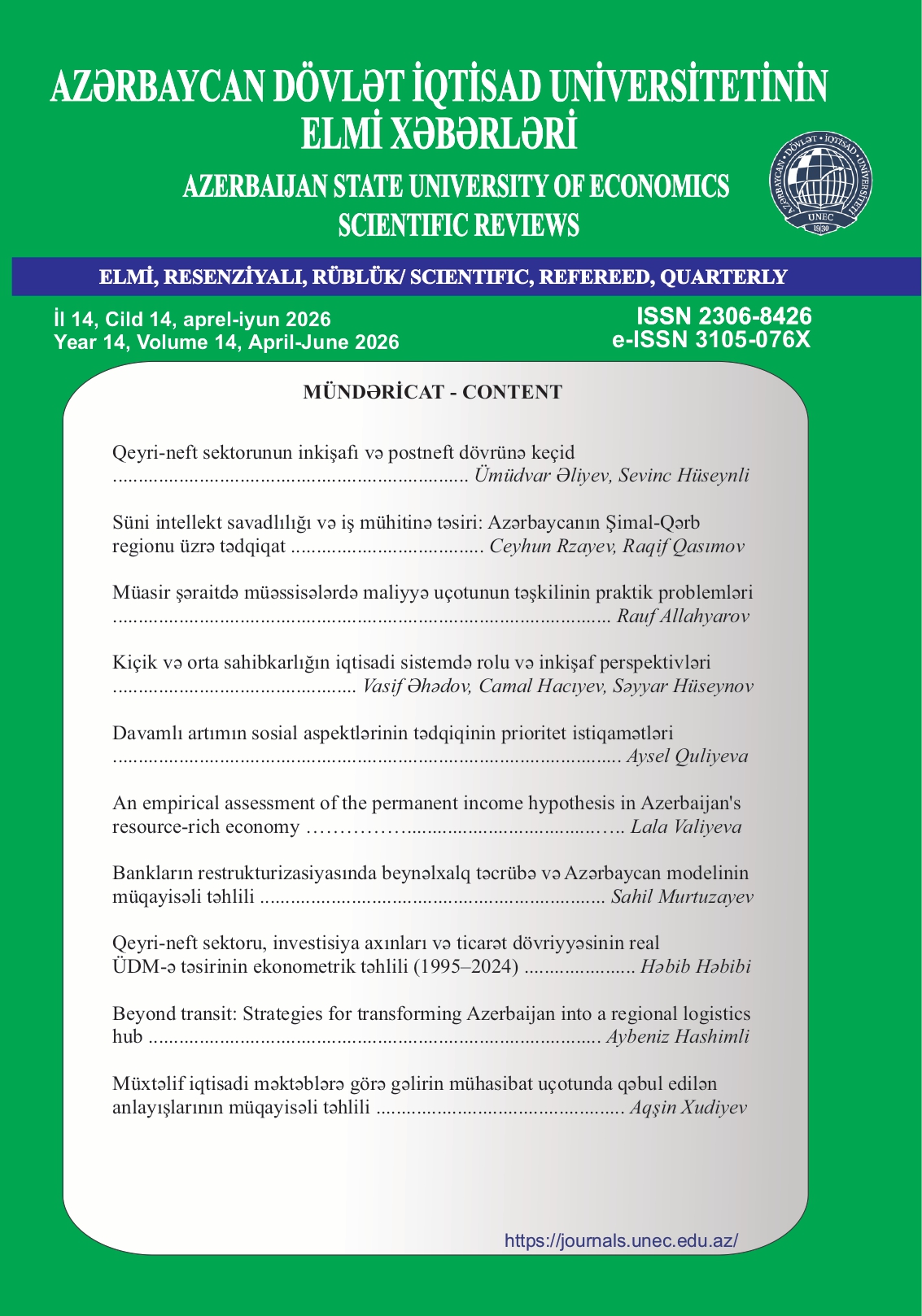
AZƏRBAYCANIN RESURSLARLA ZƏNGİN İQTİSADİYYATINDA DAİMİ GƏLİR HİPOTEZİNİN EMPİRİK QİYMƏTLƏNDİRİLMƏSİ (2005-2024)
DOI
https://doi.org/10.30546/UNECSR.2026.02.408Açar sözlər
Daimi Gəlir Hipotezi, istehlak davranışı, neft gəlirləri, ehtiyat qənaət motivi, makroiqtisadi tarazlıq, reqresiya analizi.Xülasə
This study empirically investigates the validity of the Permanent Income Hypothesis (PIH) and the Keynesian Consumption Paradigm in Azerbaijan’s resource-rich economy for the period 2005–2024. Utilizing a Robust OLS regression framework, the research examines the structural dependence of private consumption on volatile oil revenues and household savings. It addresses a critical gap in macroeconomic literature by analyzing how transitory oil wealth shocks are moderated by precautionary saving motives in a post-Soviet context.
Empirical findings reveal a significant “wealth stabilization effect,” suggesting that household savings act as a critical buffer against external income shocks. Specifically, the estimated elasticity for oil revenues and bank deposits indicates that Azerbaijani households maintain relatively stable consumption patterns despite commodity price volatility. This lower marginal propensity to consume out of transitory oil wealth provides strong theoretical support for Friedman’s PIH. The results highlight that in resource-dependent emerging markets, the interplay between financial depth and consumption smoothing is pivotal. These insights offer valuable implications for fiscal and monetary policy, emphasizing financial mechanisms that incentivize long-term savings to maintain macroeconomic equilibrium and sustainable economic prosperity.
Endirin
Yayımlanıb
Nömrə
Bölmə
Lisenziya
Müəllif hüququ (c) 2026 Lala Valiyeva (Author)

Bu çalışma Creative Commons Attribution 4.0 International License ile lisenziyalanıb.