
A NORMATIVE–INSTITUTIONAL MODEL OF PUBLIC PARTICIPATION AND SUBSTANTIVE EFFECTIVENESS IN URBAN GOVERNANCE: THE CASE OF AZERBAIJAN
DOI:
https://doi.org/10.30546/UNECSR.2026.02.01.127Keywords:
public participation; urban governance; institutional design; deliberative democracy; local self-government; governance effectivenessAbstract
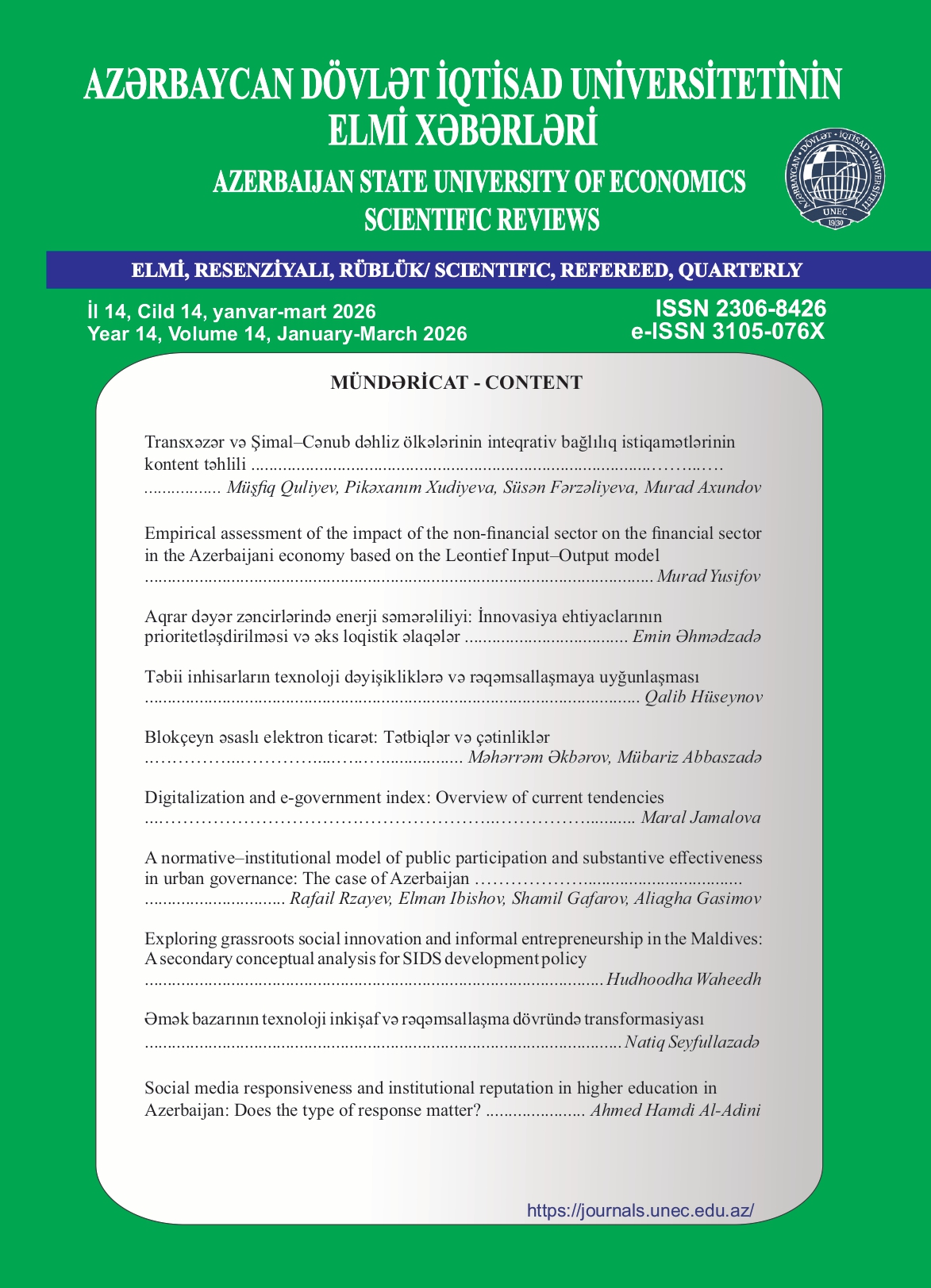
This study develops a theoretically integrated normative–institutional framework for analyzing the structure, functioning, and effectiveness of public participation mechanisms in urban governance in Azerbaijan. The article addresses a structural paradox observable in transitional governance systems: the existence of formal legal guarantees of participation does not automatically generate substantive influence over policy outcomes.
The research adopts a qualitative normative–institutional analytical design grounded in legal text analysis and conceptual modeling. A three-level framework is constructed linking (1) normative legal foundations, (2) institutional practice and authority allocation, and (3) governance outcomes. Drawing upon deliberative democratic theory, participatory power redistribution models, institutional design scholarship, and post-centralized governance literature, participation effectiveness is conceptualized as a function of four interdependent structural variables: legal thickness (LT), real decision-making authority (RA), transparency and feedback regimes (TR), and social capital density (SC). The model assumes institutional complementarity, meaning that weakness in any single dimension constrains overall effectiveness.
The analysis suggests that Azerbaijan possesses a relatively comprehensive legal architecture regulating citizen engagement, including constitutional provisions and sectoral legislation. However, fiscal centralization, limited binding force of consultative mechanisms, and uneven civic capacity may restrict the substantive depth of participation. The study integrates normative democratic theory with institutional political economy analysis and proposes a structured explanatory model applicable to post-centralized governance contexts. The framework provides a foundation for empirical operationalization, indicator-based assessment, and comparative regional research.
Downloads
Published
Issue
Section
License
Copyright (c) 2026 Rafail Rzayev, Elman Ibishov, Shamil Gafarov, Aliagha Gasimov (Author)

This work is licensed under a Creative Commons Attribution 4.0 International License.